GJE works directly with start-up companies across the UK, Europe, and further afield. Early-stage companies often have a dual focus of developing their core business and technology, whilst also securing investment to fund research and development. A common challenge is knowing how best to protect their innovation to facilitate commercial success and prevent others from copying key ideas. Additionally, for chemistry-based start-ups, there are questions of how to begin carrying out chemistry research and starting the scale up process.
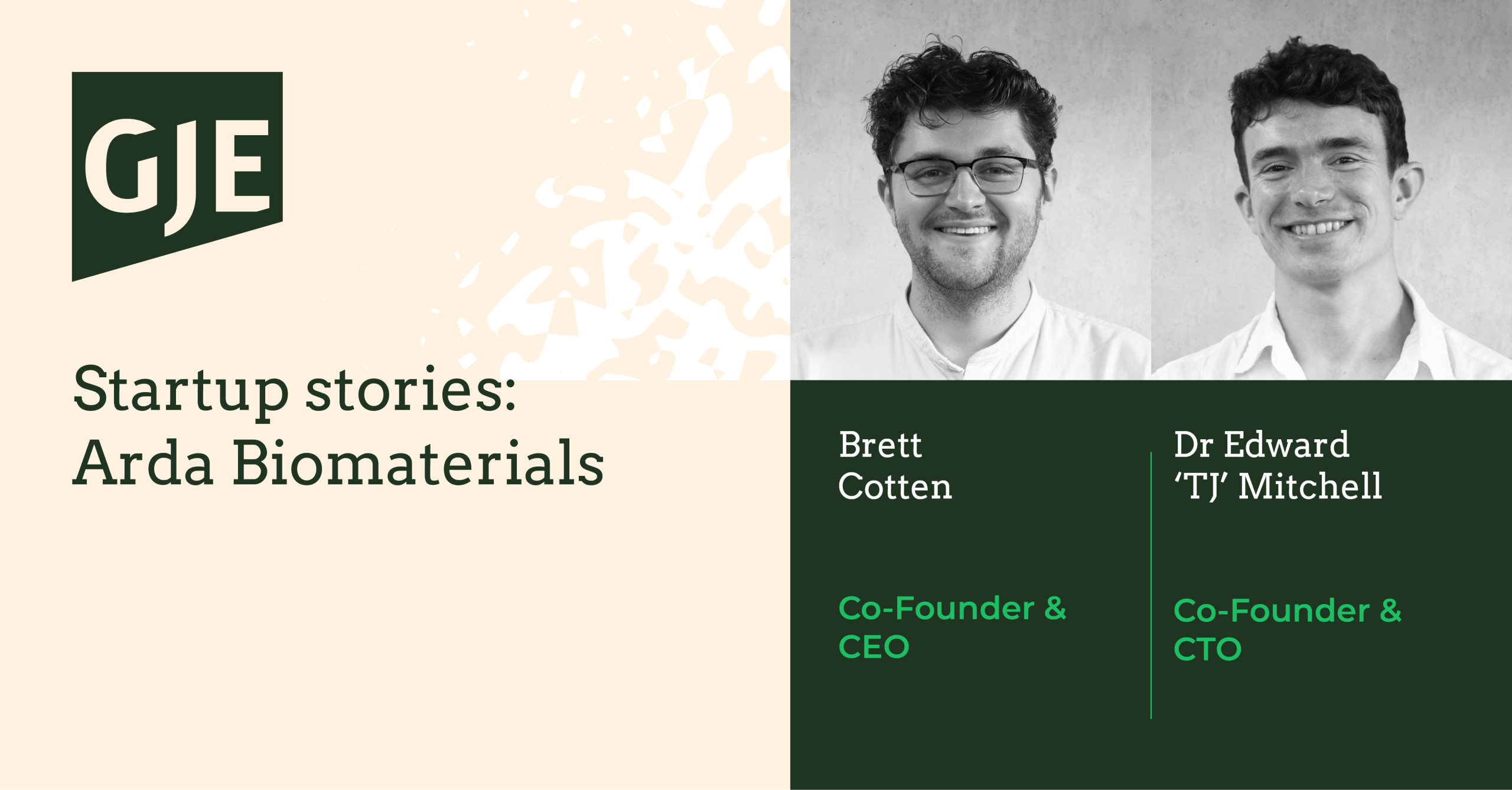
Brett Cotton (CEO) and Dr Edward ‘TJ’ Mitchell (CTO), co-founders of Arda Biomaterials, sat down with GJE associate Brenna Howley to discuss the challenges and successes they have faced as a chemistry start-up, and the role IP has played for them so far.
Arda Biomaterials is a London-based early-stage company transforming spent-grain waste from the beer industry into leather-like materials. Arda’s novel biomaterials mimic the structure of animal proteins and replace the need for plastics, tapping into an already existing supply chain and making use of waste feedstock.
Could you please share the story behind Arda and what inspired you to establish the company?
We met during the accelerator program Entrepreneurs First, which is a little like Love Island meets Dragon’s Den – you go into the programme to find a business partner, but if you don’t find someone you get kicked off. There’s lots of making up and breaking up, but once you find someone that you want to build a company with, you have one month to finalise your idea and pitch for investment. It’s an intense process.
We met at a kick-off weekend in the pub and both realised we are passionate about sustainability – in particular, removing animals and plastics from the supply chain. The first idea we had was completely different to what we are doing now. We pitched the idea at a competition event and although we didn’t win, we realised we have a strong working relationship, so we concentrated on developing another business idea together.
After talking to several brewers on the Bermondsey Beer Mile in London, we realised that their waste grain provided a feedstock with a really rich protein content. After considering various products we could make from this waste material, our focus then quickly turned to leather, which we felt was really in need of replacement by a scalable sustainable alternative material.
So, we obtained some spent grain from a Bermondsey brewery and started doing experiments in TJ’s kitchen. These first crude samples were enough for Entrepreneurs First to believe in us, and they gave us initial investment back in July 2022. We then moved into a small lab in west London and started developing the product, which we called “New Grain”.
Please could you tell us about your success in fundraising rounds?
In March 2023, we raised £1.1 million, which allowed us to hire a team and build a more bespoke lab close to the Bermondsey brewers. In October 2023, we then received a grant from Innovate UK that allowed us to bring on further chemists, and more recently, we closed a funding round of £4.05 million. This investment will enable Arda to roll out the commercialisation of New Grain and to further improve material performance characteristics.
How has your IP supported your fundraising rounds and relations with investors?
It’s pretty critical. All investors have wanted to know that we have a solid IP strategy and if we have the potential to, or have already, filed patents to protect our innovation. It also helps working with a firm that is well regarded by the likes of the Financial Times, as it gives confidence to investors in our IP strategy.
Having an IP portfolio importantly provides us with options to license out our technology, as well as build and scale-up our production while protecting our technology. This keeps our options open for future growth and collaboration opportunities.
As a chemistry-based startup, could you tell us about the process of establishing your lab and scaling up?
TJ borrowed a lot of lab equipment from different start-ups in London and started doing experiments from his kitchen.
In our view, there is a lack of lab space in London, especially for small companies. However, we were lucky to initially sublease from someone else. That gave us a leg up at the start when we didn’t have much money.
When scaling up, we wanted to continue working in central London because we felt that would enable us to seek investment, be close to fashion clients, and retain and build the talent within our team. Thanks to our recent investment success, we have recently moved into a bespoke repurposed archway on the famous Bermondsey Beer Mile which will support our next stage of growth.
What challenges have you faced as a chemistry startup?
The perception of us being a chemistry company is quite hard to push out there because people associate it with big giant chemical plants and not, for example, chemistry-based companies such as ours, which fit into the thriving biotech startup scene.
Sustainability is a key focus for Arda. How are you working towards your sustainability goals, both in your products and in the way you work?
In our products, we are looking to be completely animal and petrochemical free. We want to ensure that our material biodegrades into nutrients to enrich the soil at end of life, rather than shedding microplastics or biodegrading by sight but leaving terrible marks in the soil. That’s critical for everything we do, and we’re very much driven by that ethos.
In the rest of our work, we focus on having a local supply chain with the vision of transforming brewery waste. Looking to the future, our sites could be co-located, or as close as possible, to the brewery sites.
We think this approach also distinguishes us from our competition. We see very large global chemicals companies or fashion brands trying to develop their own materials, but these are absolutely loaded with plastic. So, it is clear to us that in order to make a difference, it will land on the shoulders of small innovators.
What have been the most significant milestones for Arda so far?
- In the very early days at Entrepreneur First, we had a sample of our protein-based material on the desk and people thought it was actually a piece of leather scrap – that was a really exciting one.
- The day before we had to pitch for Entrepreneur First, we went up to Cambridge and pitched in an alternative protein competition at the business school. We didn’t win first place and there weren’t supposed to be any other prizes, but they liked us and created a second place prize there and then, and we received funding.
- The day our head of design made our first bag in house. Our team has also made a beautiful shoe which has won two awards.
- We made it onto the 2024 Forbes 30 under 30 Europe list in the manufacturing and industry category.
- We met the King.
- We collaborated with Been London – a fashion brand based in Hackney Wick, and with Beavertown Brewery to make card holders from the waste grain from their breweries.
How has your approach to IP evolved as the business has grown?
At the beginning, we were very much trying to protect our core material. Then, as we’ve developed and improved our material, we’ve been able to seek protection for those with other key patent applications to build up our portfolio.
As an R&D intensive company, it is important to have an IP strategy in place when pitching to investors for current, ongoing and future materials. They want to see that we are continually innovating, and making improvements to our products.
Looking ahead, what are your growth plans for 2026 and beyond?
We are going to expand the team. At the moment, we are predominantly a research and development team, but we’re looking to bring in engineering and commercial hires and to commercialise our first products with well-known fashion brands.
It will still take some years of development, but early next year we want to get out to market. We’ve done showpieces, but now we want to scale up to an industrial process and get products to customers.
In the growth of Arda, we have found that it’s really important to lead with the science and then the design of the products becomes the bridge between the science and the commercial aspects.
Finally, what advice would you offer to early-stage chemistry startups navigating similar challenges?
Don’t be afraid to take risks.
Reach out to everyone for help. We had a lot of help from the start from academics who were really keen to work with us and were happy to offer lab space. Make sure you build those connections.
Focus on the big advantages in your storytelling. Chemistry has so many advantages – in particular, its scalability. This approach can produce products that reach price points that are competitive.
Related resources

GJE announces alliance with Wächtershäuser & Hartz
GJE is pleased to announce that the firm has formed an alliance with the German patent and trade...
Startup stories: Audoo
GJE works with start-up companies across many sectors both in the UK and worldwide. A common challenge in...
Startup stories: Daphne Technology SA
Alistair Holzhauer-Barrie in conversation with Dr William Ramsay and Janne Berglund GJE works directly with companies across the...