
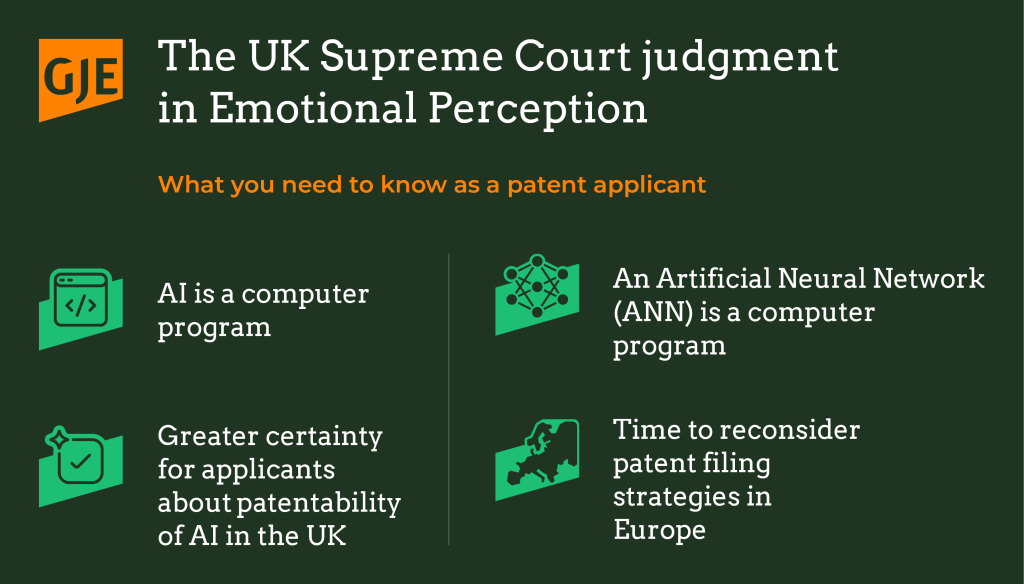
The epic Emotional Perception case reached an initial conclusion at the UK Supreme Court in February, as reported previously. In that much-anticipated decision, the UK Supreme Court abandoned 20 years of precedent and discarded the Aerotelapproach for assessing whether a computer program should be excluded from patentability. In doing so, the Supreme Court aligned the UK approach with the “any hardware” approach applied by the European Patent Office (EPO).
The Supreme Court actually found in favour of the applicant, and allowed their appeal. The patent application had been refused because it was considered to relate to a computer program as such, which was excluded from patentability. Having abandoned the Aerotel approach, the Supreme Court concluded that this decision was wrong. Under the new approach mandated by the Supreme Court, the claims were not excluded as a computer program because they included aspects of hardware, which (in a literal sense) are not computer programs. The case was therefore remitted to the UKIPO to consider whether the claims meet the other requirements for patentability, and specifically whether they are novel and involve an inventive step.
The UKIPO issued its latest examination report on this case on 28 May 2026 in which it concluded that the claims lack an inventive step. The next step is likely to be a hearing where the application is likely to be refused for a second time.
In forming their opinion, the UK examiner reviewed the claims to identify those features that contributed to technical character. As a reminder, the invention in this case relates to a technique for generating media file recommendations using an Artificial Neural Network (ANN.). First, the examiner considered the straightforward implementation of an ANN on a computer (or other dedicated hardware). In their opinion, this would involve the manipulation of data on a machine, but would not provide a “further technical effect”, beyond the normal physical interactions that can be expected whenever software is run on a computer. Second, the examiner considered the steps of providing a “better” media file recommendation, in the sense that the recommendation is more likely to be considered useful by a human user. The examiner argued that the mapping of attributes of data to subjective attributes that humans would perceive in audio/video/image also does not have technical character. Consequently, the examiner did not find any technical character in the implementation of the invention in an ANN, nor in the broader objective of generating a subjectively useful media file recommendation.
The examiner then followed an approach that will be very familiar to applicants at the EPO in striking out claim features that are considered not to contribute to technical character. After “filtering” out non-technical features, the examiner was left with a significantly shortened claim:
A method of providing files on a computer system including:
a processor (or processors) which is capable of hosting artificial neural network (ANN) models and training ANN models,
a computer memory that can store a database that stores data files,
a communications network that can send files to users,
a network-connected user device coupled to the communications network and capable of outputting content of files.
This is, of course, a fairly banal set of features that can be found in a wide variety of computing devices. Indeed, the examiner concluded that these features could be found in the closest prior art document. The technical features were not considered to be novel, and the examiner concluded that any novel features must relate to non-technical features. Non-technical features cannot contribute to inventive step, and therefore the examiner argued that the claims must lack an inventive step.
This long-running patent application was initially filed in April 2019. It was refused, appealed to the High Court, then the Court of Appeal, and finally the Supreme Court. The next step is likely to be a UKIPO hearing on the question of whether the claims involve an inventive step in a technical field. The application looks set to be refused once more, and it will be interesting to see whether the applicant files yet another appeal and whether the saga continues. Whatever happens, we will continue to monitor this fascinating case.
Please feel free to get in touch with your usual GJE attorney, if you would like to discuss how this might affect your portfolio, or any specific cases.
Related resources
An end to an emotional journey: The UK Supreme Court concludes the Emotional Perception saga
Today, the UK Supreme Court (UKSC) has delivered a historic, and much anticipated, ruling concerning the patentability of...

What is a computer? What is a technical contribution? Insights from the Emotional Perception AI v UKIPO appeal
As we have reported previously, the High Court’s remarkable decision to overturn a decision of the UKIPO regarding...

Emotional Perception AI: A “Frankenstein” approach to patentability? Insights from the UK Supreme Court hearing
We examine the Emotional Perception AI (EPAI) v UKIPO appeal hearing at the UK Supreme Court about the...