
The UKIPO has now released a practice notice which explains how examiners should apply the Supreme Court’s ruling in the Emotional Perception case. This practice notice will affect the examination of UK patent applications that involve computer implemented inventions.
The practice notice includes a long introduction that provides background and context for the Supreme Court decision, and a very short section that provides specific guidance for examiners. It is a surprise that the actual guidance is so brief. Perhaps the UKIPO expects that the new approach will be very easy to apply!
As we reported previously, the UKIPO has recently issued an examination report in relation to the Emotional Perception patent application. The logic used in this examination report is repeated in the guidance.
The practice notice explains that examination should involve three distinct steps:
- the “first hurdle” – decide whether the subject matter of the claim qualifies as an invention by applying the “any hardware” approach;
- the “intermediate step” – identify the features of the claim which contribute to the technical character of the invention, viewed as a whole; and
- the “second hurdle” – assess whether the invention is new, then whether it involves an inventive step in relation to the prior art by considering only those features which do so contribute to technical character
On the first hurdle, the guidance to UK examiners can be reduced to a single sentence:
Any claim which involves technical means (e.g. some form of computer hardware) is an “invention”.
The “intermediate step” should explicitly be performed after the first hurdle and before the second hurdle. For this step:
Examiners should identify that a feature contributes to the technical character of the claim, viewed as a whole, if it contributes to, or interacts with, the technical subject matter of a claim for the technical solution of a technical problem
UK examiners are also referred to the EPO Guidelines for Examination, which includes sections that provide guidance on how to distinguish between technical and non-technical features. Although UK examiners are not bound to follow the EPO approach, the question is the same and the guidance is thought to be helpful.
The second hurdle is effectively the application of the normal principles concerning novelty and inventive step. For this step, UK examiners are referred simply to the relevant sections of the Manual of Patent Practice, and reminded that only the technical features identified in the intermediate step can be taken into account.
One curiosity about the new approach is that the intermediate step explicitly must be performed after the “first hurdle” and before the “second hurdle”. However, in both the first hurdle and the intermediate step, it is necessary to identify technical features in the claim. In that sense, the first hurdle seems to be answered as a consequence of applying the intermediate step. In the intermediate step, if a single feature is identified that contributes to technical character then, logically, the claim must also involve technical means and must qualify as an invention. It will be interesting to see how this apparent contradiction develops in practice, and whether the first hurdle and the intermediate step emerge as genuinely different types of enquiry.
We expect UKIPO examiners to apply the first hurdle and the intermediate step in much the same way as EPO examiners. We expect to see examination reports where claims are marked up to strike through features that are considered not to contribute to technical character of the claim. Applicants will need to engage with the process and develop arguments that claim features contribute to technical character, when viewed as a whole. When drafting new applications, it will be important to include claim features that involve technical considerations, and cannot easily be discounted in the intermediate step analysis. Otherwise, there will be nothing left in the claim when the examiners arrive at the second hurdle and assess novelty and inventive step.
Please feel free to get in touch with your usual GJE attorney or email us (gje@gje.com), if you would like to discuss how this might affect your portfolio, or any specific cases.
Related resources

Emotional Perception – the story continues
Last week the UKIPO issued its latest examination report in the long-running Emotional Perception case, concluding that it...
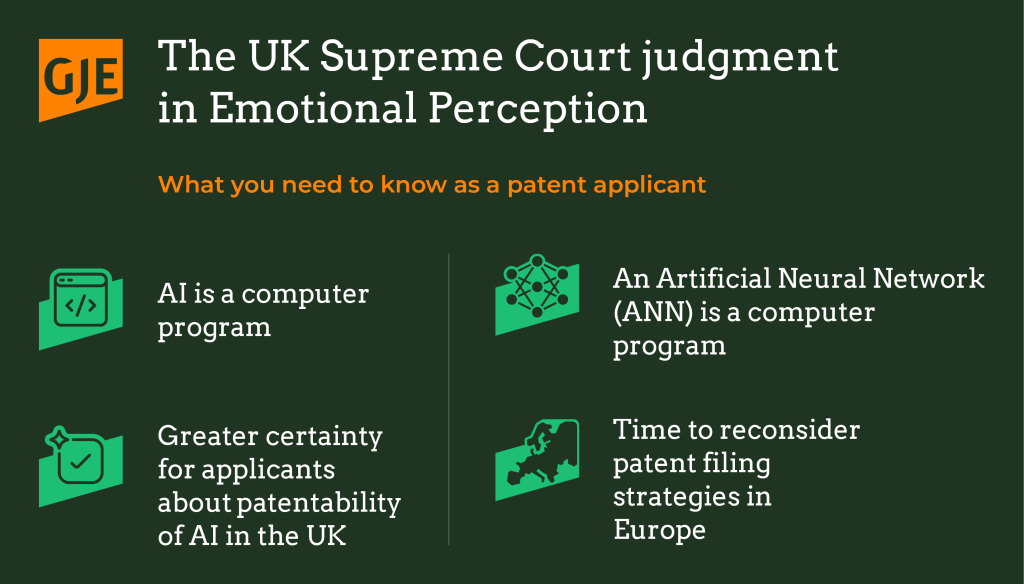
An end to an emotional journey: The UK Supreme Court concludes the Emotional Perception saga
Today, the UK Supreme Court (UKSC) has delivered a historic, and much anticipated, ruling concerning the patentability of...

Emotional Perception AI: A “Frankenstein” approach to patentability? Insights from the UK Supreme Court hearing
We examine the Emotional Perception AI (EPAI) v UKIPO appeal hearing at the UK Supreme Court about the...