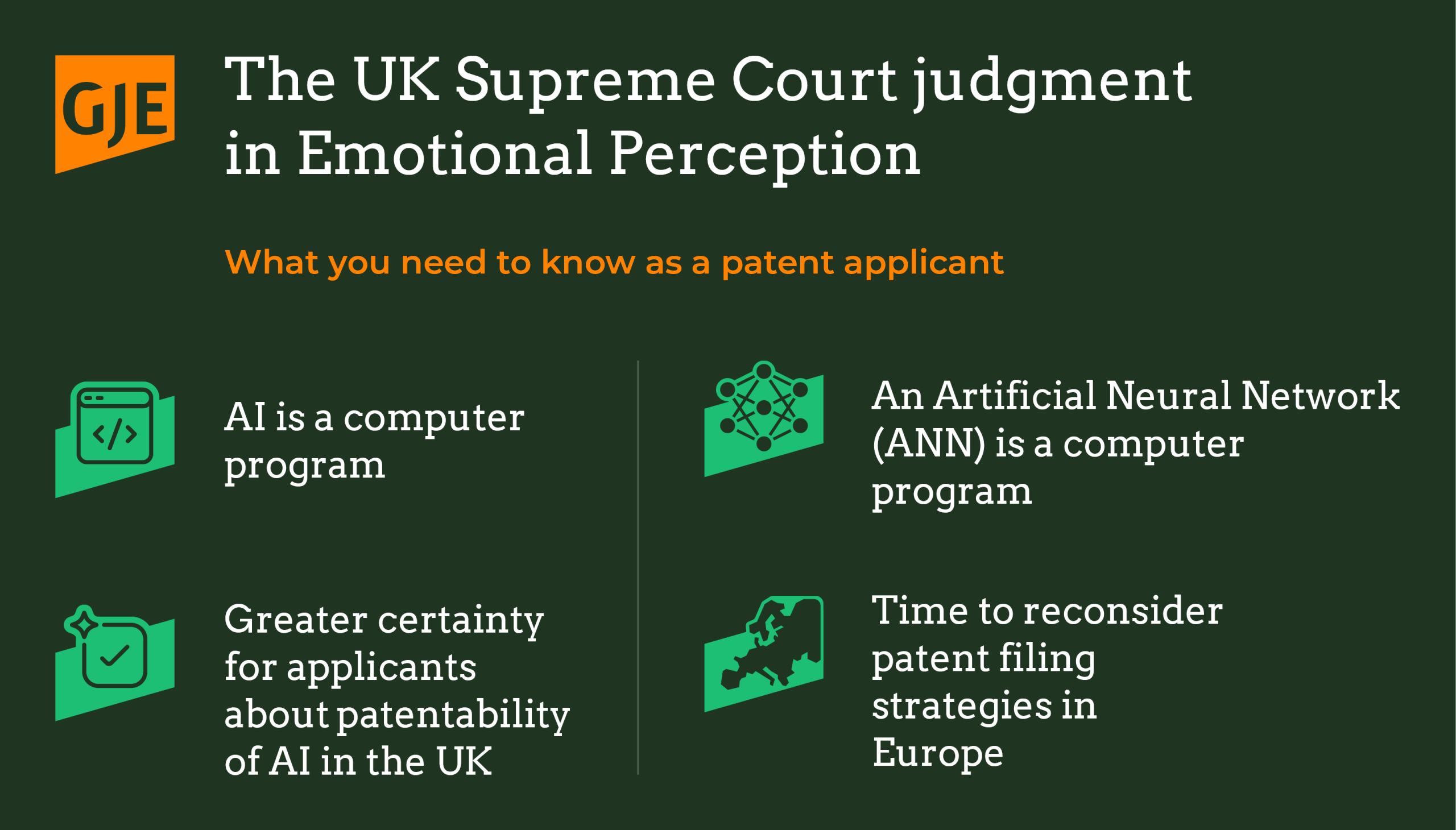
The long‑running Emotional Perception case reached its decisive conclusion today as the UK Supreme Court (UKSC) delivered its highly anticipated judgment in Emotional Perception AI Ltd (EPAI) v Comptroller‑General of Patents.
This ruling is particularly significant as it is the first time the UK Supreme Court has ever considered the patentability of a computer-related invention.
Below, we have highlighted the key takeaways from the judgment.
Judgment summary
- No more Aerotel
The UKSC explicitly rejects Aerotel for assessing patentability of computer inventions, instead confirming a new approach based on the European Patent Office’s (EPO) “any hardware” and Comvik principles should be adopted. This aligns the UK with the EPO.
- An artificial neural network (ANN) is a “program for a computer”
The UKSC have stated that an ANN is an abstract model that, when implemented on hardware, constitutes a set of instructions that causes a machine to process data in a particular way. It is therefore a computer program regardless of whether it runs on conventional CPUs, FPGAs, neuromorphic chips, or has fixed (“frozen”) weights.
- EPAI’s ANN involves technical means
EPAI’s ANN recommends media (e.g., songs) based on “emotional similarity” determined from physical file properties rather than human assigned metadata. Applying the new “any hardware” test, adopted from the EPO, the subject-matter of the claims involves technical means (computer hardware, database, network, user device). The presence of hardware means the UKIPO’s refusal on the computer program exclusion cannot stand.
- Remittal back to UKIPO
The UKSC have concluded that the case is to be sent back to the UKIPO to apply the new framework as follows: (i) confirm the “invention” via the new any hardware test; (ii) decide which claim features contribute to technical character; (iii) then assess novelty and inventive step considering only the features that contribute to the invention’s technical character.
The supreme court stated “[it] is, however, open to the UKIPO and the UK courts to adopt any appropriate method of identifying the technical character of the invention, viewed as a whole…” We therefore look forward to more clarification on how to assess the UK patentability of software inventions in the coming years.
Brief recap on the timeline of events
Below is a brief reminder of the Emotional Perception journey that has spanned the UKIPO, the High Court, the Court of Appeal, and finally the nation’s highest court, the Supreme Court. For detailed comments on each stage, click through to our related articles below.
As of 11 February 2026, the UKSC has remitted the case back to the UKIPO for re-assessment of patentability
Supreme Court reasoning:
- The Court has overruled Aerotel for assessing exclusions under s.1(2)/Art 52 EPC and aligned UK law with the EPO. Going forward, a claim clears the “invention” hurdle if it involves any technical means (“any hardware”), and a mandatory “intermediate step” should be performed to identify, feature by feature, which elements contribute to the invention’s technical character before turning to novelty and inventive step.
- An ANN is a “program for a computer” because the ANN’s topology, activation functions, and learned weights/biases together constitute instructions that cause a machine to process data in a particular way, irrespective of implementation (CPU, FPGA, neuromorphic hardware) or whether weights are “frozen”.
- In the particular case of EPAI’s claims, these are not excluded “as such” since they involve technical means (computer hardware, database, network, user device) and therefore have technical character.
- The Court remits to the UKIPO to re-assess patentability, including novelty and inventive step.
Consequences: It is likely that more cases will get past the “excluded subject matter hurdle” and stand or fall at inventive step.
The steps leading to this point are set out below:
- The invention & initial UKIPO refusal (Pre 2023)
EPAI developed an ANN that recommends media (e.g., songs) based on “emotional similarity” determined from physical file properties rather than human assigned metadata.
EPAI filed a UK patent application for this ANN. The UKIPO rejected the application on the ground that the ANN fell under the statutory exclusion for a “program for a computer…as such” in section 1(2)(c) of the Patents Act 1977, which excludes computer programs from patentability.
- High Court Appeal (EPAI wins) – 21 November 2023
EPAI appealed the UKIPO’s rejection to the High Court, which overturned the UKIPO’s decision.
High Court’s key findings:
- A trained ANN is not a computer program because, after training, it “operates according to something that it has learned itself” rather than simply executing human written instructions.
- Even if considered a computer program, the ANN did make a technical contribution, because it outputs and delivers a recommended file based on ANN analysis, involving moving a music file from one medium to another, which the court saw as a technical effect.
Consequences: The patent should not be excluded under s.1(2)(c) and EPAI temporarily won. Following the High Court ruling, there was a short lived shift at the UKIPO toward treating certain ANN inventions more favourably.
- Court of Appeal (High Court overturned; EPAI loses again) – 19 July 2024
The Comptroller General (UKIPO) appealed to the Court of Appeal, which restored the UKIPO’s original rejection.
Court of Appeal’s reasoning:
- A computer is “a machine that processes information” and an ANN fits this definition regardless of implementation.
- A computer program is “a set of instructions for a computer to do something”.
- ANN weights and biases are instructions, so a trained ANN is a computer program.
- EPAI’s invention did not make a technical contribution, because the core contribution was seen as “an ANN based system for providing improved file recommendations” not something achieving a technical process beyond information processing.
Consequences: The Court of Appeal’s decision caused the UKIPO to withdraw earlier guideline changes that followed the High Court ruling and to reaffirm treating ANN implemented inventions like all other computer implemented ones.
- Permission to Appeal & Supreme Court Hearing – November 2024
The UKSC granted EPAI permission to appeal with the hearing being held on 21-22 July 2025. The Supreme Court posed the following central questions for discussion:
- Does the “program for a computer…as such” exclusion apply to ANNs?
- If yes, does EPAI’s ANN make a technical contribution that takes it outside the exclusion?
Please get in touch with our attorneys at gje@gje.com if you would like advice about AI patentability.
Related resources

GJE announces alliance with Wächtershäuser & Hartz
GJE is pleased to announce that the firm has formed an alliance with the German patent and trade...

What is a computer? What is a technical contribution? Insights from the Emotional Perception AI v UKIPO appeal
As we have reported previously, the High Court’s remarkable decision to overturn a decision of the UKIPO regarding...

Emotional Perception AI: A “Frankenstein” approach to patentability? Insights from the UK Supreme Court hearing
We examine the Emotional Perception AI (EPAI) v UKIPO appeal hearing at the UK Supreme Court about the...