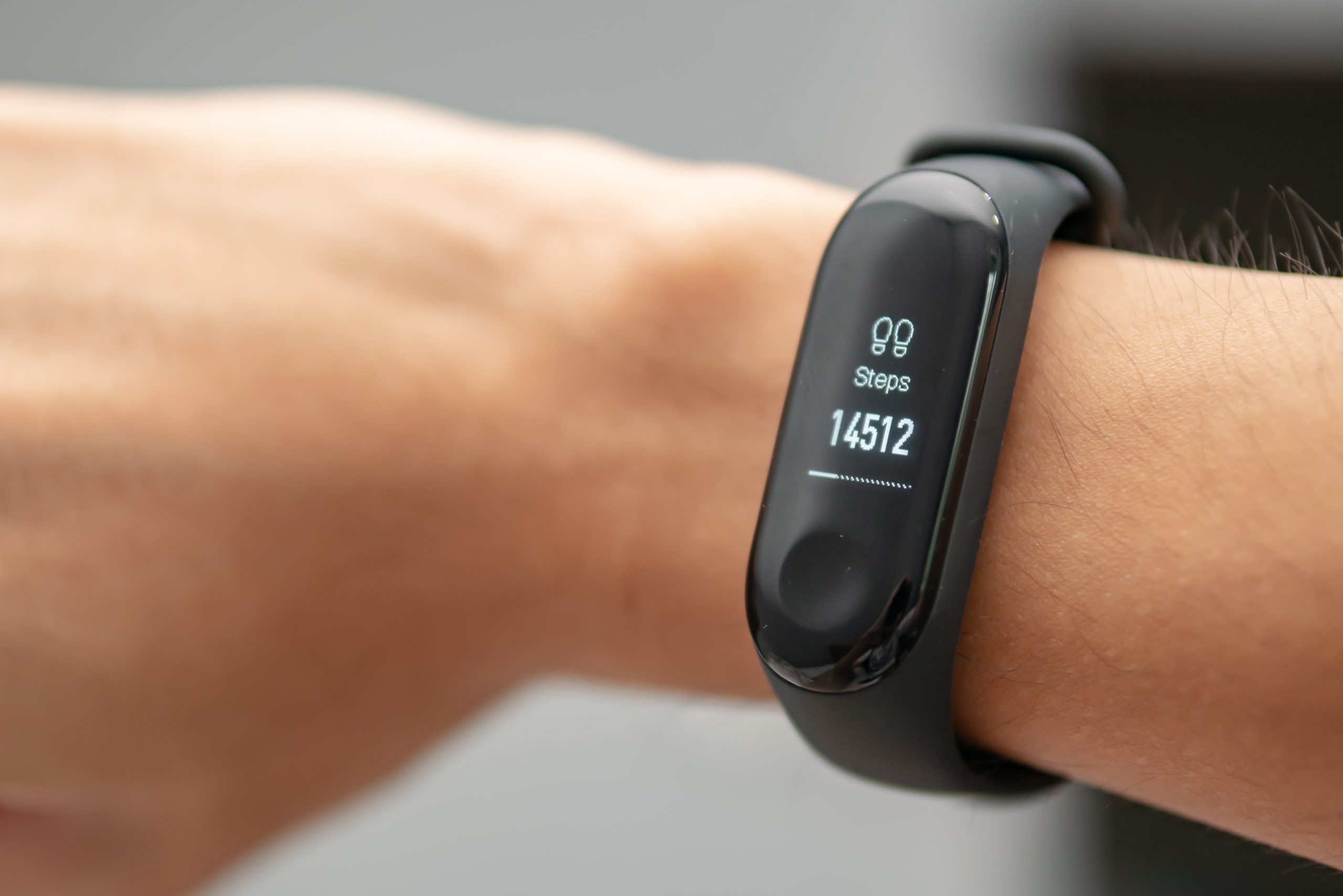
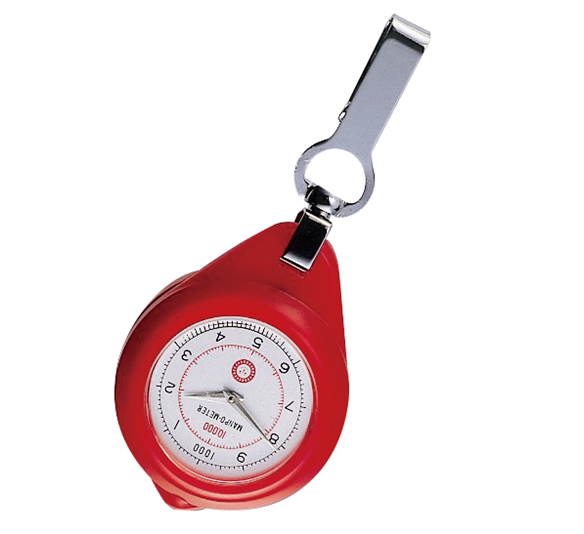
Ahead of the 1964 Tokyo Olympics, a Japanese clockmaker began marketing a small, waist-worn device known as the Manpo-kei (万歩計). The idea behind the device was simple: allow users to track their daily step count to encourage higher levels of physical activity at a time when rising convenience culture was reducing everyday movement in Japanese society.
The device is widely regarded as the first commercially promoted pedometer and proved highly successful. Indeed, the device established the now-familiar daily target of 10,000 steps, a benchmark that remains embedded in many modern fitness trackers and health apps, with the name “Manpo-kei” literally translating as “10,000 step meter”.
The choice of this target, however, appears to be less scientific than its enduring popularity might suggest. Most accounts agree that figure was not grounded in rigorous scientific research but instead was chosen primarily for its numerical appeal and memorability, making it ideal for product branding. Some accounts even suggest that the number was selected because the Japanese character for 10,000 (万) resembles a person walking.
Source: Wikimedia Commons
Despite this relatively recent commercial success, the concept of the pedometer itself has a much longer history.
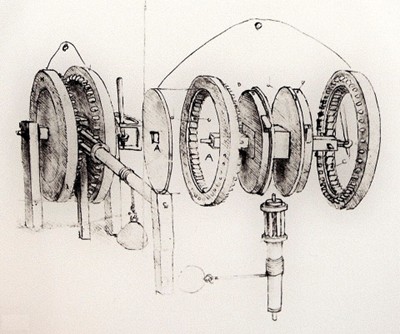
The earliest conceptualisation of a pedometer is credited to Leonardo da Vinci in the 15th century, who sketched plans for a gear-driven device including a pendulum arm configured to swing back and forth with each step. The design is thought to have been conceived for military use, enabling the estimation of distances marched by soldiers based on their step count. However, as with many of da Vinci’s designs (such as his well-known 15th century “helicopter” sketch), there is no evidence that his pedometer was ever actually constructed.
Source: Wikimedia Commons
The earliest practical realisation of a pedometer is often attributed to a French physician and mathematician, Jean Fernel, in 1525. Fernel is said to have devised a rudimentary step-counting mechanism using a cord attached between the wearer’s belt and knee, allowing each stride to be mechanically registered. The device enabled him to estimate distances travelled by counting steps. Fernel reportedly also applied similar mechanical principles in an odometer fitted to a carriage wheel in an early attempt to measure the circumference of the Earth.
Over the following centuries, pedometer designs became progressively more sophisticated and self-contained. Later devices replaced external cords with compact internal mechanisms, typically using spring-suspended levers or pendulum systems that moved in response to the motion of the wearer’s body. Each oscillation triggered a simple mechanical counting mechanism, providing a measure of the number of steps taken.
While these mechanical refinements improved accuracy and convenience, the primary purpose of pedometers remained distance measurement rather than the monitoring of personal fitness – a focus that finally shifted with the introduction of the Manpo-kei in the 1960s.
Over the following decades, step-tracking functionality moved into electronic devices, enabled by the emergence of micro-electromechanical systems (MEMS) accelerometers and gyroscopes. These tiny sensors made it possible to detect motion electronically rather than mechanically, allowing devices to calculate step counts from characteristic patterns of acceleration associated with walking or running. MEMS sensors offered several advantages over earlier mechanical designs: they were smaller, more reliable, orientation-independent, and could be integrated directly into consumer electronics such as smartphones and wearable devices.
While standalone, hip-mounted pedometers like the Manpo-kei eventually fell out of favour, the broader idea of measuring personal activity endured. Health and fitness tracking has since expanded far beyond basic step counting, with modern day wearables integrating a wide array of physiological monitoring technologies and sensors such as optical heart rate monitors, oxygen saturation meters, GPS receivers, and temperature sensors. By combining multiple sensors with sophisticated data processing techniques, modern wearables are now increasingly able to deliver personalised insights into health and fitness.
From an intellectual property perspective, this evolution has redirected the focus of innovation in the field. Early pedometers were purely mechanical, with progress centred on relatively straightforward physical mechanisms. By contrast, much of the value in modern wearables lies in their software, with recent advancements in machine learning and data analysis techniques dramatically enhancing the predictive and analytical capabilities of these devices.
This shift in innovation has introduced complex questions around patentability. Not all software-based innovations are eligible for patent protection, and assessing whether a particular technology qualifies can be challenging. For companies developing new wearable technologies, navigating these issues is a crucial part of a robust intellectual property strategy.
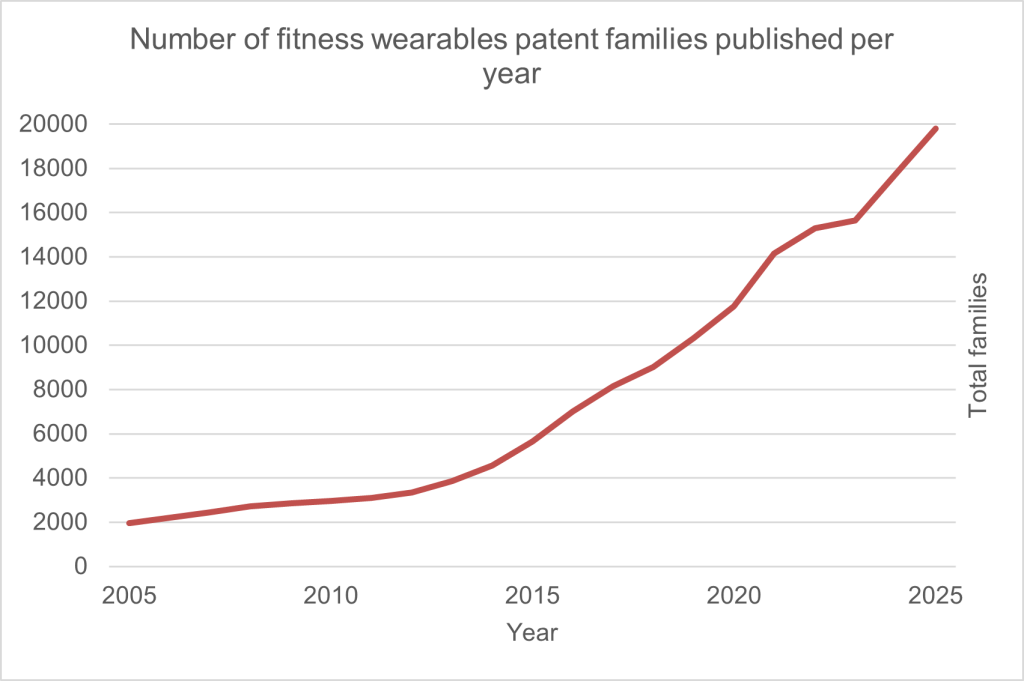
Despite these challenges, there has been clear upward trend in wearable-related patent filings in recent years, as illustrated in the patent families graph below. This trend reflects both the pace of innovation in the sector and the commercial importance of protecting it.
Source: PatBase
If you are working on innovations in wearable devices, our team would be happy to discuss how patent protection can help support and safeguard your developments.
For any questions regarding patent protection in the wearable device sector, or the broader health and fitness technology space, please email our dedicated sports technology team at gje@gje.com.
Footnote
* generated using PatBase Analytics based on the query: (IC=A61B5/00*) AND (wearable* OR sport* OR fitness* OR athletic* OR exercise* OR training* OR performance* OR “physical activity” OR athlete* OR cycling* OR running* OR “fitness tracker” OR watch* OR wristband* OR “smart band” OR “activity tracker” OR “activity monitor” OR “heart rate monitor” OR “training device” OR “performance monitor” OR “sleep tracker” OR “smart clothing” OR “smart apparel” OR “smart ring” OR “health band”)
Related resources

GJE announces alliance with Wächtershäuser & Hartz
GJE is pleased to announce that the firm has formed an alliance with the German patent and trade...

How rock climbers held on to their (commercial) edge
In this article, we explore the development of an essential piece of climbing equipment, belay devices, and how...

Patent Law & Practice at a Glance – April 2026
Read our April 2026 edition of patent law and practice which includes updates from the UK, the EPO...