
Introduction
In 2025 the UKIPO issued 10 decisions on patent applications for computer implemented inventions (CIIs) that were refused for lacking a technical contribution and relating to a computer program, as such. In order to reach this point, each of the 10 applications had reached the end of the process with a patent examiner. The applicant in each case requested an oral hearing in order to argue their case in front of a hearing officer.
In the decisions, which are summarised below, the hearing officers consistently focused on what the inventions actually contributed, rather than the sophistication of the implementation of the usefulness of the outcome. Although there were 10 different applicants, each hearing resulted in a negative outcome, and none of these patent applications were allowed. This demonstrates that it is unusual for the UKIPO to reverse its position in a hearing in cases like these. In order to avoid the exclusion, applicants must do more than merely show the practical usefulness of an idea: the claimed invention must deliver a direct, concrete technical effect such as improving the operation of a computer, controlling a technical process or producing a technical outcome that is beyond the presentation of information.
O/0057/25 – Sophos Ltd
The invention in this case provided a method for providing an accurate natural language description of a command line. The invention would provide an explanation of command line text for a person who was not skilled or experienced in command prompt code. The technique involved generating several natural language descriptions and selecting one that was determined to be most accurate.
The hearing officer found that the contribution included providing the user with an accurate natural language description of a command in order to allow a less skilled user to understand that command. In effect, the invention was characterised as a translation tool for assisting a user to interpret a command. This was not considered to be a technical benefit because it simply involved translating a command line from one format to another. The fact that the invention provided a more “accurate” natural language description was considered to be subjective, and not technical either.
O/0154/25 – Eye Inside LLC
The invention provided a technique that could be used on real estate for-sale boards. The for-sale board would be modified to include an alphanumeric code, which could be input to a website. The website would then display a map based on the user’s location and including an indicator for the for-sale property.
The applicant argued that the invention provided a technical benefit in reducing fuel consumption because a user could more quickly navigate from their location to a desired for-sale property. The hearing officer dismissed this argument because the alleged technical benefit did not flow directly from the claimed method, but was merely a potential or speculative benefit. For the applicant’s argument to have been persuasive, the claim would have needed to include a more tangible technical output such as a modification to a vehicle, but no features like these were present in the patent application.
O/0213/25 – Spatialbuzz Ltd
The invention involved determining a priority value for faults in a communications network. The method involved considering subjective data from users regarding their perception of performance of the network, and determining priority values for faults. In the applicant’s opinion, this provided a technical benefit because it could allow a network operator to prioritise engineering resources. However, the claimed method did not actually involve any interventions in the communications network. Therefore, the hearing officer found that it could be characterised as a business method for allocating engineering resources in order to optimise customer satisfaction levels. This was considered to be no more than a method of doing business, and the implementation of this business method in a computer program did not render it technical either.
BL O/0599/25 – Nvidia Corporation
The invention relates to a system that gathers multiple types of gameplay information and uses neural networks to provide gameplay suggestions to players. Incoming data is turned into feature vectors and placed into a latent space that reflects how the game state changes over a period of time. This allows the system to give advice that takes account of recent context rather than looking only at the immediate situation.
One question was whether the use of a latent space built from feature vectors collected over a gameplay window was an obvious development of known tutorial systems. The hearing officer accepted that although latent spaces and time-based analysis are familiar concepts, nothing in the cited material directed the skilled person toward applying them in this way. An inventive step was therefore acknowledged. However, the application was still refused because of a lack of a technical contribution. The contribution of the invention was seen as a system that produces guidance to assist gameplay, which was deemed to be a computer program as such and a method of playing a game.
BL O/0722/25 – Corey Kaizen Reux-Savonte
The invention relates to arrangements for validating cryptocurrency transactions and rewarding activity within a distributed ledger network. The system includes nodes that check balance information, handle data submitted by users and apply peer involvement when confirming or approving contributions. During prosecution, the claims were amended in an attempt to broaden the scope of protection from that defined in the originally filed claims.
Two issues had to be addressed. The first was whether the amended claims introduced subject matter extending beyond that of the application as filed. After comparing the application as filed with the amended claims, the hearing officer agreed with the examiner that the amendments removed important limitations and added new material.
The second issue was whether the contribution provided any technical effect. The hearing officer concluded that the claimed arrangements amounted to a business method implemented on standard computing infrastructure, and so did not provide a technical contribution over the prior art. The application was therefore refused.
O/0390/25 – Bandai Namco Entertainment Inc.
The invention related to a system for initiating and assessing gathering events for multiple users. The system initiated a gathering event that was sent to user terminals alongside a map showing the gathering location. The system then determined the success or failure of the gathering event based on gathering conditions and rewarded the users if the gathering event was deemed a success, the determination of success based on the positions of the users.
The hearing officer considered the contribution to be determining whether the gathering event was successful by checking whether enough players had reached the gathering location. Using real‑world location data and mapping to determine whether the gathering was a success was considered well‑known and merely part of the game mechanics rather than solving any technical problem. The application was refused for being nothing more than a combination of computer programs and a method of playing a game.
O/0528/25 – International Business Machines Corporation (IBM)
The invention relates to an iterative method for identifying previously unknown molecular dynamic state structures and the associated data points corresponding to atoms or groups of atoms. It detects statistically meaningful, often rare, states by separating abnormal data and inferring targeted states through statistical analysis. These newly identified state structures can then be used to support the discovery of new drug targets.
The hearing officer found that the invention merely processed data to identify molecular states which, although previously unknown, already existed and were not designed or altered by the method. While the invention provided a new way of identifying rare events and anomalies within the data, it did not amount to a real‑world technical application, since the output state information did not itself enable or imply any specific technical use. In particular, although such information might assist later drug‑target research, it did not provide a direct path to drug design and was therefore regarded as academic rather than technical. As the invention did not design anything new but simply processed data describing existing states, the contribution could not be considered a technical design activity, which would be a subsequent step. Since the method was implemented entirely on conventional hardware, the contribution was excluded as a computer program as such.
O/0739/25 – Lenovo (Beijing) Limited
The invention in this case relates to a multitasking interface displayed on an electronic device. The interface includes two types of cards: active cards, linked to running applications, and shortcut cards, linked to inactive ones. The multitasking interface can be partially superimposed on currently displayed content on the screen.
The hearing officer found that the contribution included displaying a multitasking interface comprising cards having operation buttons that let users interact with the corresponding applications. The hearing officer concluded that the invention provides a new user interface which is merely a new way of presenting information. The improvement lies only in how information is presented to the user as there is nothing which suggests that a device’s technical performance is improved. The argument of the applicant that displaying the interface on currently displayed contents provides an improved user interaction experience, was considered an improved method of presenting information rather than an improvement in a technical sense.
O/0756/25 – Blackhawk Network, Inc
The invention relates to a method of purchasing non-fungible tokens (NFTs) at a point of sale (POS). A user device requests an NFT through a digital marketplace, with access limited by the user’s geographic location. The purchase is validated via a code exchange with an NFT processor, which converts the request into a barcode for POS scanning. Once payment is confirmed, the NFT is delivered to the recipient.
The applicant argued that converting the purchase request into a POS-scannable code, validating the request, and filtering NFT offerings by geographic location each provided a technical contribution. The hearing officer disagreed, finding these features to be conventional steps necessary for enabling an NFT purchase at POS and not providing technical contribution. The hearing officer concluded that the contribution lies in a particular method of conducting a particular financial transaction, falling within the business-method exclusion. Although the method may offer an efficient and effective way of acquiring NFTs, it remains a business process, and the implementation of this business method in a computer program did not render it technical either.
O/1146/25 – Macusoft Ltd
The invention relates to treating macular disease using intra‑ocular injections. At each diagnostic session, retinal thickness and visual acuity are measured and used to calculate a “response number” which is a weighted measure of change between visits that quantifies improvement, stability, or deterioration in the patient’s eye condition. The clinician then uses this information to determine whether the patient requires a shorter or longer recall period before the next injection. A graphical user interface (GUI) can visualise retinal thickness over time, helping clinicians track spatial and temporal disease progression and more easily recognise emerging patterns.
The hearing officer considered the contribution to be a GUI for displaying image data on a graph and concluded that presenting data in this way did not constitute technical processing. There was nothing inherently technical in the chosen format of presentation, even if it enabled the clinician to understand the data more easily. Arranging information within the GUI to help clinicians make decisions more quickly did not create any meaningful interaction between the user and the system beyond providing a static display of information. When considering whether the data processing might avoid exclusion as a computer program, the hearing officer found that any effect outside the computer was limited to the clinician being able to spot patterns more readily. Although this may reduce the clinician’s cognitive burden, it does not constitute a technical effect, nor does it directly influence any external technical process. Diagnostic or treatment decisions remain the responsibility of the clinician. The invention was excluded as relating to both the presentation of information and a computer program as such.
Conclusions
This set of decisions confirms that the UKIPO continues to apply a demanding and consistent standard when assessing computer-implemented inventions. Applicants should therefore take particular care to file patent applications that relate to genuine technical improvements such as changes to computer operation or control of an external technical process rather than improvements in information processing, presentation, or decision-making, if they are to avoid this exclusion under UK patent law.
Please feel free to get in touch at gje@gje.com if you would like our opinion on the likelihood of success of your patent application in the UK.
Related resources
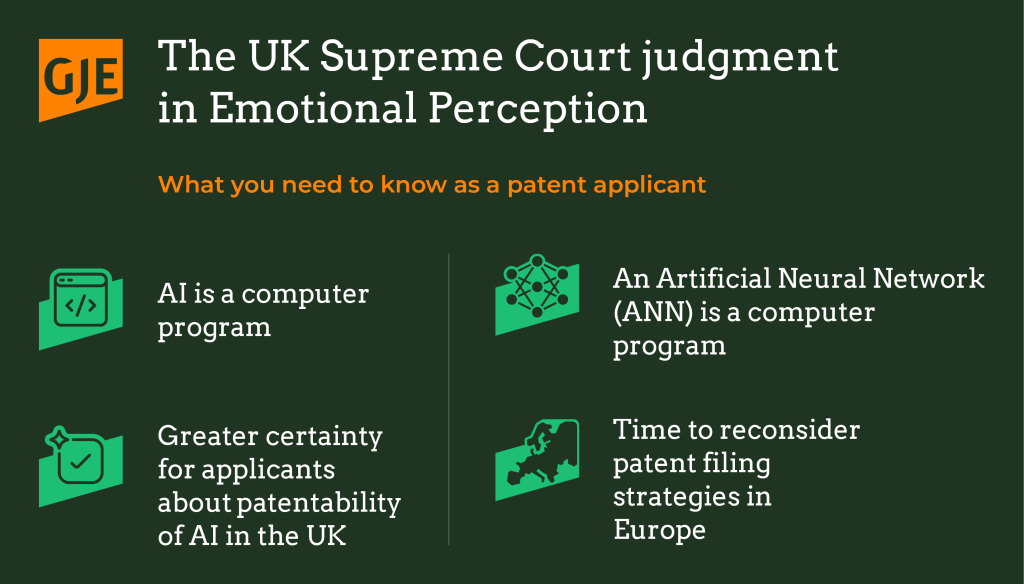
An end to an emotional journey: The UK Supreme Court concludes the Emotional Perception saga
Today, the UK Supreme Court (UKSC) has delivered a historic, and much anticipated, ruling concerning the patentability of...

Can an AI patent stop a copycat in another jurisdiction?
In this article, we outline the challenges of enforcing AI-related patents across jurisdictions and strategies to protect AI...

The hidden risks of using LLMs in the inventive process
Artificial intelligence is reshaping how people invent. Large Language Models (LLMs) can now assist with brainstorming, drafting technical...