
Long before a biotech start-up has a product, it has a story written in data. Teams are running assays, screening compounds, engineering cell lines and refining therapeutic candidates, all with the aim of reaching the next technical milestone and securing further investment. In doing so, they often rely on existing scientific tools, materials and methods, many of which may already be protected by patents.
Founders are often aware that patent law provides certain research exemptions, particularly the exemption for acts carried out for “experimental purposes”. This can create the impression that research-stage activities are largely insulated from infringement risk, at least until a product reaches the market. However, the reality is more nuanced. While the experimental use exemption can be valuable in many circumstances, its scope is narrower than many assume. Understanding where the boundaries of this exemption lie can help avoid unexpected infringement risks and inform strategic decisions about licensing, freedom-to-operate (FTO) and future product development.
Understanding patent infringement
A patent gives its owner the right to prevent others from carrying out certain acts in relation to the patented invention, in the territory where the patent is in force and for the duration of the patent term (usually up to 20 years from filing). In general, under the UK Patents Act 1977, infringement of a product patent includes making, using, keeping, importing or disposing of a patented product. For a process patent, it includes using that process or offering it for use.
In the life sciences sector, a company can encounter third-party patents long before it has a commercial product ready for market. Patent protection often extends beyond the final therapeutic or diagnostic product and may cover research reagents, screening assays, cell lines, vectors, manufacturing methods, therapeutic agents, biomarkers or platform technologies used throughout the research and development pipeline. As a result, researchers may use patented technology at a very early stage of product development. Hence, infringement issues can arise early during the research stage, even where a company’s own product candidate is still years away from clinical development. Accordingly, it is important to consider infringement risks throughout the research and development (R&D) process rather than only at the point of market entry.
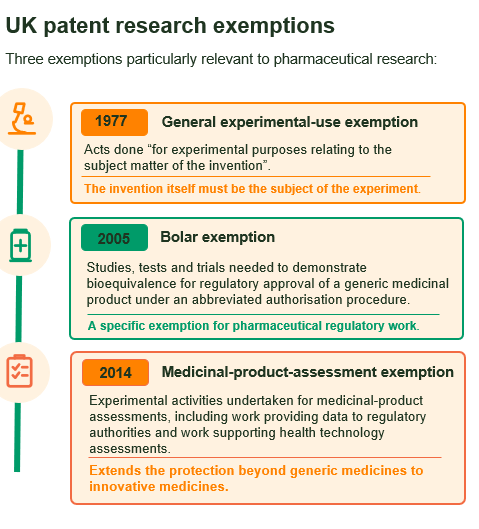
UK patent research exemptions
The patent system relies on a balance between protecting innovation and allowing others to scrutinise and investigate, verify and build on technology. To preserve that balance, UK and EU law provide several exemptions to patent infringement that permit limited use of patented inventions in circumstances that would otherwise constitute infringement.
For instance, in the UK Patents Act 1977, there are several statutory exemptions particularly relevant to research inventions that include amongst others:
- Private and non-commercial use – acts done privately and for purposes which are not commercial (s.60(5)(a));
- Experimental use – acts done for experimental purposes relating to the subject matter of the invention(s.60(5)(b));
- The “Bolar exemption” and “medicinal-product-assessment” exemption (s.60(5)(i) and s.60(6D) to (6G)) – are narrowly targeted at trials and studies needed to support regulatory approval of medicines and obtain marketing authorisation.
Understanding the boundaries of “experimental purposes” under s60(5) UKPA
The statutory wording is deceptively brief. If the use of a patented invention in the course of research were always permissible, it would clearly destroy the value of patents for scientific instruments designed for research applications.
The important limitation lies in the phrase “relating to the subject matter of the invention”. That is, research and development activities directed towards an existing patented invention will generally not constitute patent infringement where the purpose of the research is to investigate, test, validate or improve the invention itself.
By contrast, what the exemption does not usually allow is using the patented invention as a tool to pursue some separate commercial or scientific objective. Because the experiment is not concerned with understanding, testing, or improving the patented invention itself, the experimental use exemption will generally not apply.
Suppose a patented cell line is available for use in drug discovery. If your company uses that cell line as intended to screen your therapeutic candidates and generate data for your own programme, the cell line is being used as a research tool rather than being the subject of the research. In such circumstances, the experimental use exemption is unlikely to apply because the experiment is directed at your therapeutic candidate, not at investigating or improving the patented cell line itself.
By contrast, if you are investigating the patented cell line itself, for example, by studying why it exhibits a particular phenotype or testing whether it can be modified to improve its stability, the cell line itself is the subject matter of the research. That is much closer to the type of activity the research exemption is intended to protect.
UK case law: defining the boundaries
The leading UK authority remains Monsanto v Stauffer. The Court of Appeal accepted that an experiment can have a commercial objective and still qualify for the exemption, and recognised legitimate purposes such as testing whether the invention works as claimed, whether it can be improved, and whether it performs under different conditions (discover something unknown; test an hypothesis; determine whether something which worked under one set of conditions would also work under a different set of conditions; or establish whether or not it is possible to manufacture commercially in accordance with a patent).
Later cases held the line: trials run to demonstrate a product to a regulator, an investor or a customer are not considered experiments in this sense, and work done simply to obtain regulatory approval fell outside the exemption. This was one of the reasons why separate, specific exemptions were subsequently introduced for medicinal products, including the Bolar exemption (for generics) and the broader medicinal-product-assessment exemption (for innovative products).
Practical takeaways for founders
None of this makes research-stage work unusually risky. These acts are designed to permit research activities which drive innovation. Additionally, many patents that appear in your path may be licensed, may be close to expiry, may not be in force in your markets, or may be narrower than they first look once their claims are properly interpreted and assessed against what you actually intend to do.
GJE works with many early-stage life sciences companies, and we are experienced in carrying out FTO reviews, identifying and monitoring third-party applications and patents that may need licensing or design-around strategies. We advise on whether relevant patents are in force, whether your work falls within the scope of the claims, and where you may have opportunities to secure protection for your own innovations. To discuss your biotech IP strategy, please email biotech@gje.com.
Related resources

Patenting pharma inventions in Europe: evidence considerations for sufficiency of disclosure
We summarise the EPO’s and the UK’s current approach to assessing whether the requirements of sufficiency are met...
Key Considerations when patenting siRNA in Europe
In the latest article in our series, we outline the key considerations for innovators and applicants when patenting...
Key considerations when patenting mRNA-based therapeutics in Europe
In this article, we explore the key considerations for innovators and applicants when patenting mRNA technology in Europe.