Recommended listening: The Beatles, Strawberry Fields Forever
The “British Invasion” was a cultural phenomenon of the 1960s, where aspects of British culture (especially music) saw a spike in popularity in America. Although the movement is probably most associated with “Beatlemania”, many other acts (e.g. The Rolling Stones) played a part. The term has also been applied to subsequent waves of British musical popularity in America, such as in the 1980s (thanks to musicians like David Bowie and Genesis) and 1990s (thanks to groups like Oasis and Radiohead).
Interestingly, every single musician mentioned above made use of a specific musical instrument in at least one of their hit songs. Despite being manufactured in the UK, this instrument (called the “Mellotron”) was derived from technology invented in America and brought to the UK under controversial circumstances. This article tells the story behind the Mellotron and how it came to be the world’s first commercially successful “sampler”.
For context, the term “sampler” refers to an instrument that creates sound by triggering playback of prerecorded samples (rather than synthesising realistic sounds completely from scratch, which as discussed in the previous article in this series, is far from simple). Therefore, before we look at how samplers work, we first need to understand how sounds can be recorded and played back.
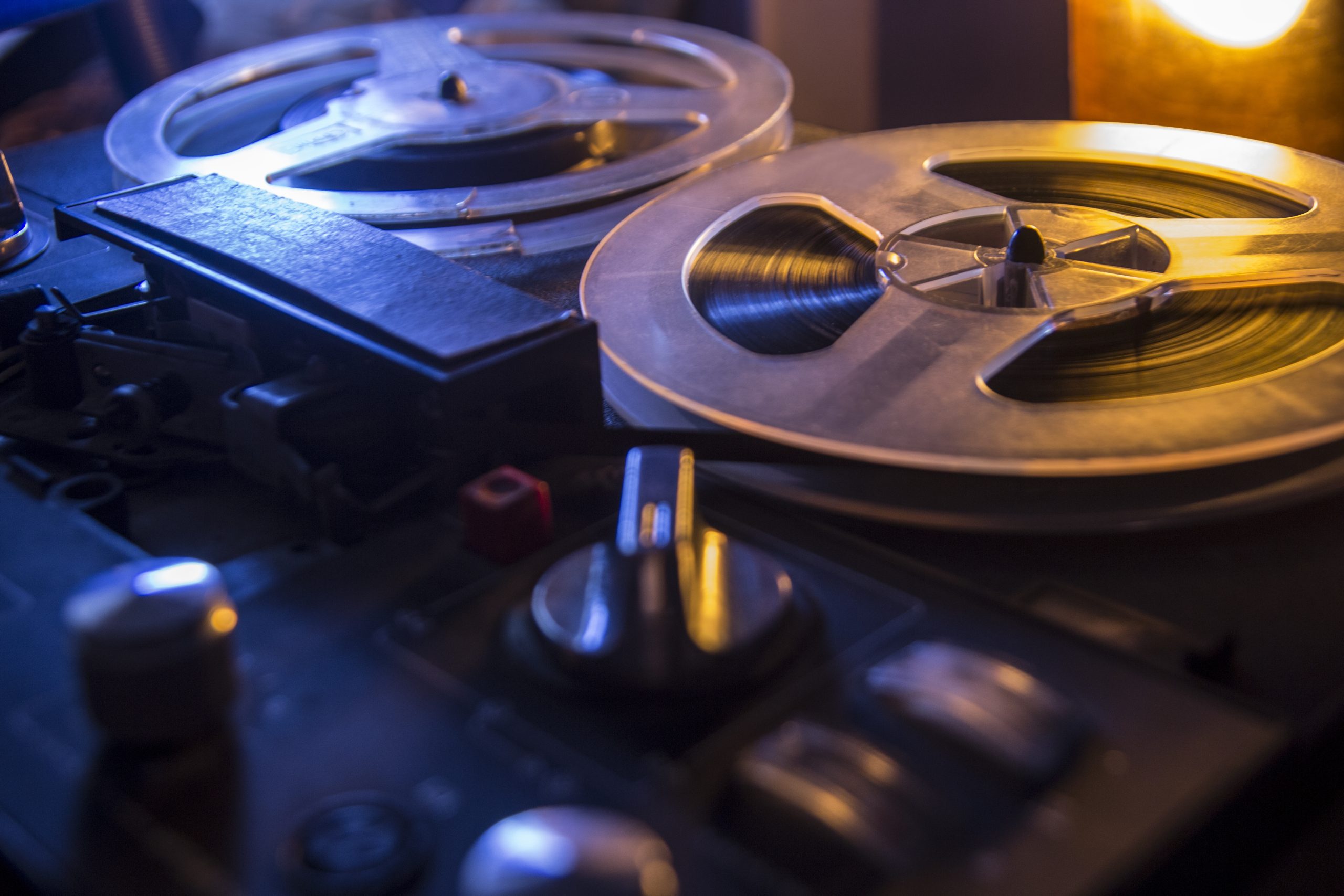
Until the late 1970s, the standard approach for storage and playback of recordings was magnetic tape. This was how the musicians were recorded in studios, how the individual recordings were combined to produce complete songs and albums (in a process known as “mixing”), and indeed how many recordings were distributed to consumers (i.e. on cassettes).
So how did tape become the standard and how did it work? The first description of magnetically stored audio was filed at the USPTO in 1878 by American inventor Oberlin Smith. His key insight was that an input (audio) waveform could drive a magnetising coil, such that the waveform could be stored on a magnetisable carrier passing by the coil. For the carrier, Smith suggested a length of thread with embedded steel particles.
Despite being the first to come up with the general idea, Smith never managed to get it to work in practice, and it would be several decades before someone else did. The first working magnetic recorder (the “telegraphone”) was created in 1898 by Danish inventor Valdemar Poulson (US661619A – granted in 1900) and used a wire as the carrier. German inventor Fritz Pfleumer substantially improved the obtainable sound quality by instead applying an oxide layer to a tape carrier (DE4500900C – granted in 1930), and Walter Weber used AC biasing techniques to further improve the sound (DE743411C – granted in 1930). While some of these approaches had already been discovered individually elsewhere, German engineers were the first to understand and capitalise fully on the huge potential of magnetic recording technology. Indeed, during WWII the allied forces could not understand how the German forces were able to broadcast pre-recorded messages at quality levels only thought possible during live broadcasts (and only discovered how when German “Magnetophon” tape machines were captured towards the end of the war).
Post-war, magnetic tape was enthusiastically adopted across the music industry. While earlier recording approaches may have required the performers to play a piece of music from start to finish, tapes allowed for different parts of different performances to be cut (literally) and spliced together to construct a “perfect” performance. Additionally, it gave rise to “multitracking” where different instruments could be separately recorded onto different reels of tape and combined later. Most of The Beatles’ albums were recorded on tape machines having only four tracks. The Beatles also found other creative ways to use shorter recorded fragments; in their 1966 song Tomorrow Never Knows, several pieces of tape are connected in loops so that the recordings on the tapes play continuously. The most noticeable of these occurs 8 seconds into the song, where a recording of Paul McCartney’s laughter was sped up so much that it resembled a seagull.
In view of the shift from an entire song on a single piece of tape, to different instruments on different pieces of tape, it did not take long for someone to consider making a musical instrument where individual notes could be played on their own pieces of tape. This “someone” was American inventor Harry Chamberlin, who invented the world’s first sampler (known as the “Chamberlin”) in 1953.
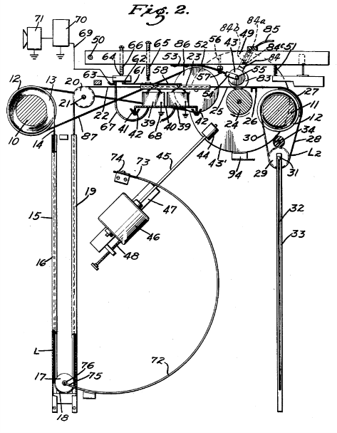
The operating principle behind his instrument is described in the patent (US2940351A), which was granted in 1960.
The movement of a key (49) engages a length of tape (13) with a motorised roller (24) and simultaneously presses it into contact with a pickup head (39). This reads the sound prerecorded on the tape and outputs it through an amplifier (70) and speaker (71). When the key (49) is released, another roller (17) immediately engages the loop of tape under the force of a spring (72) such that the tape is rapidly reset to its starting position.
This clever mechanism meant that each press of a key could produce a repeatable recording of a particular sound at a particular pitch. Different sets of tape recordings could be installed in the instrument to provide a variety of sounds from flutes to trumpets to voices.
The distribution of the Chamberlin was limited to the US and Canada, with Chamberlin making use of his family and even his window cleaner, Bill Franson, to advertise and distribute the product. Despite Franson’s squeaky-clean reputation and desire for transparency, he decided to bring some of Chamberlin’s products to the UK in 1962 without his knowledge. This led to the manufacture of a similar product from 1963 called the “Mellotron” (a combination of melody and electronics) with the assistance of a local engineering company (Bradmatic/Streetly Electronics). Although his US patent did not have direct legal effect in the UK, Chamberlin was evidently unhappy with the situation and was able to reach a settlement whereby Mellotrons could only be distributed in the UK.
Despite these geographical limits, the Mellotron became very popular and was used by many major British artists. It featured in a few of The Beatles’ recordings including the iconic flute sound in “Strawberry Fields Forever” (1966 – demonstrated by Paul McCartney himself here). The recording of “Tomorrow Never Knows” mentioned above also uses the flute and strings sounds on the tape loops that appear 22 seconds and 38 seconds into the song. It can be heard in David Bowie’s “Space Oddity” (1967) for the orchestral swell leading into the chorus and the strings in the chorus itself. Oasis used it in “Wonderwall” (1995) for the cello sound that enters from the second verse.
Notably (and perhaps unfairly), it was the UK-manufactured Mellotron that achieved worldwide fame rather than the original US-manufactured Chamberlin. The IP lesson from this is clear; since patents only offer regional protection, inventors should make sure that they file patents in each jurisdiction where they may want to commercialise their products. Had Chamberlin done so, he may have been able to collect a substantial amount of licensing revenue off the back of the Mellotron’s success.
By the late 1990s, the recording industry was shifting from analog recordings on tape to digital recording formats. Similarly, analog samplers like the Mellotron were moving out of common usage in favour of the much more convenient digital samplers and synthesisers, the development of which will be discussed in the next (and final) instalment of this series.
If you would like to discuss anything in this article further, or you have an invention that you would like to protect, then please contact the author, or get in touch with our patents team at gje@gje.com.
Related resources

FM synthesis – How one of Stanford University’s most profitable licensing deals defined the sound of the 1980s
In the latest instalment of our music technology series, patent attorney and amateur musician, Alexander Norden explores the...

The Moog – How the synthesiser gave J.S. Bach his first platinum record
In the latest instalment of our music technology series, patent attorney and amateur musician Alexander Norden explores how...
Theremin: What the world’s purest sounding instrument can teach us about heavy metal music
The theremin is one of the most fascinating intersections of physics, engineering, and music history.