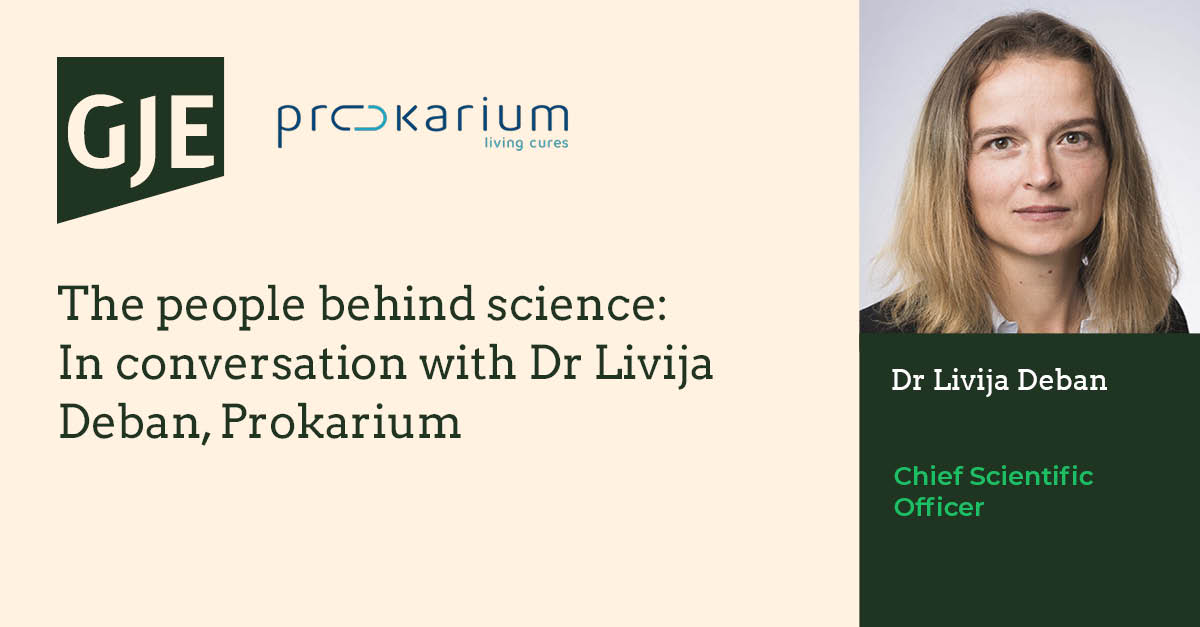
To mark London Life Sciences Week 2026, we are delighted to feature an interview with Dr Livija Deban, Chief Scientific Officer at Prokarium, a biopharmaceutical company focused on microbial immunotherapy. Here we explore her perspectives on the evolving life sciences sector, the opportunities and challenges shaping the industry, and her personal experiences throughout her career.
Tell us about your career journey and what initially attracted you to the life sciences sector.
I have been fascinated by biology and nature’s many solutions to as many problems for as long as I can remember. As I grew, I became increasingly aware of how many answers we still lack, and I saw my place in trying to contribute to answering some of those questions.
Doing that successfully requires both understanding, knowledge of how biological systems work, and the technical ability to interrogate and ultimately influence them, which is why I chose to study medical biotechnology at the intersection of science and technology. During my studies, I developed a firm appreciation of both the possibilities and limitations of technology, while also falling in love with the complexity and central role of the immune system. I followed immunology into my PhD, asking a deceptively simple question: how do we define what is normal, and how does that determine what we call disease? From there, I was privileged to see how some of those fundamental principles could be translated into health applications, and I followed that north star into trying to programme the immune system to recognise and fight cancer.
The underlying motivation has never really changed – to understand how we work as biological entities – but over time it expanded into wanting to make that understanding useful, what I think of as “applied understanding”. That is where I am today as Chief Scientific Officer of Prokarium, a clinical-stage London biotech firm, engineering bacteria to treat cancer.
In your view, what are the most exciting opportunities emerging in the life sciences sector today?
It is hard to single out just one exciting opportunity – we live in a time of extraordinary technological advances that are opening multiple avenues of progress towards applied understanding. One example is what attracted me to Prokarium: the potential of bacteria to treat cancer has been recognised for well over a century, but today we finally have the tools to purposefully engineer the properties needed for an effective anti-cancer response while engineering away many of the traits that make bacteria dangerous.
More broadly, increasingly granular biological datasets are giving us a much more detailed view of disease pathways and, importantly, of how those pathways interact rather than operate in isolation. At the same time, machine learning and AI are shortening the path from biological insight to the design of potentially useful therapeutic molecules and constructs. Together, these advances create enormous potential for more rationally designed therapies that are not only more effective, but also safer. That has always been one of the central challenges in drug development – potency often comes at the cost of toxicity. We are increasingly gaining the tools to separate the two and widen the therapeutic window.
What do you see as the biggest challenges the industry will need to address over the next 5 to 10 years?
One of the biggest challenges is capital allocation, particularly in Europe. Bold ideas require bold capital, and the current biotech funding environment is strongly risk-averse, with much of the available capital flowing towards later-stage assets and programmes perceived as already de-risked. We may be creating a system in which everyone wants to invest after proof of concept, but too few are willing to fund the work required to generate that proof – and that could backfire in the coming years.
Beyond funding, we will also need appropriate frameworks for AI contributions to intellectual property, including increasingly difficult questions around inventorship, ownership and what constitutes defensible innovation. Another challenge is ensuring that increasingly sophisticated and personalised therapies do not tip over into systems that are too complex to manufacture, scale and make broadly accessible. However personalised the end product becomes, the underlying platforms and infrastructure still need to be robust.
In many ways, the challenge of the next decade will be not only to invent better medicines, but to build the financial, legal and technical frameworks that allow genuinely innovative therapies to progress from idea to broad patient use.
Based on your personal experience, what insights, lessons, or perspectives would you like to share with others working in or entering the industry?
Where I stand currently, I see three things as key to a fulfilling career in biotech.
First and foremost, the team. Drug development is a team endeavour, and the quality of the people around you matters enormously. The people you embark on the journey with will become your “brothers in arms”, and building that trust early will get you through when the going gets tough – and it always does in biotech. I also think of the team quite broadly: your ecosystem of investors, collaborators, advisers and consultants has a big role in the success of the company. By that, I don’t mean surrounding yourself with like-minded people. I mean go as diverse as you can – shared values matter, but shared thinking does not. Constructive pushback is essential, particularly when conviction around a programme or hypothesis becomes strong, because someone needs to keep asking what you might be missing. Ultimately, the best teams are those that can challenge each other openly, make decisions with imperfect information and then move forward together.
Secondly, learning to be rigorous, ruthless and flexible, all at the same time. You frequently have to make important decisions without all the evidence that, as a scientist, you would ideally like to have. Conversely, there are always many questions that could be asked. Deciding on the right question to ask and the most informative experiment to perform is a fundamental skill for scientists in biotech. Rigour comes in the execution – experimental and operational; ruthlessness is key in selecting candidates and viable programmes and maintaining laser-sharp focus; flexibility refers to the ability to pivot when needed and when indicated by the data.
And finally, never forget to have fun. Biotech is hard, but it is also enormously rewarding, and maintaining perspective while knowing that your work just may help someone live a better, longer or healthier life is the balance I strive for.
What skills or mindsets do you think are most important for driving innovation in the life sciences sector?
As in most high-risk sectors, I think the central mindset needed to drive innovation in the life sciences is that of the infinite game. Curiosity, continuous learning, adaptability and the ability to recognise opportunity are just some of the qualities needed to keep making progress. Being comfortable with uncertainty is fundamental, particularly in biotech, where waiting for complete information usually means waiting too long.
I also strongly value being modality-agnostic – starting with the disease and the problem you are trying to solve, rather than with the technology you happen to have. Most importantly, as AI and other tools make it increasingly easy to generate hypotheses and possibilities, I think critical thinking and judgement will become ever more important. The scarce skill will increasingly be deciding which ideas are actually worth pursuing.
To discuss your biotech IP strategy, please contact our biotech team: biotech@gje.com.
Related resources

Turning science into value: Top tips for an effective life sciences IP strategy
With London Life Sciences Week starting on 15 November, we’re sharing our top ten practical tips for building...
Startup stories: Arda Biomaterials
We sat down with the company’s co-founders Brett Cotton and Dr Edward ‘TJ’ Mitchell to discuss the challenges...
Startup stories: Audoo
GJE works with start-up companies across many sectors both in the UK and worldwide. A common challenge in...