
Recommended listening: Wendy Carlos, Switched-On Bach
In the last instalment of this music technology series, I mentioned one of the icons of the synthesiser world, Robert Moog. Following his experiments with the theremin in the 1950s, he went on to become a key figure in the development of the synthesiser as we know it today; in particular, he was responsible for manufacturing the first commercially available synthesiser in 1964, named the “Moog” (which rhymes with “vogue”).
The Moog had many features that set it apart from its contemporaries. The Moog synthesiser was “modular”, which meant that it included several modules that could be interconnected together in different ways by “patch cables”. These modules integrated several innovative voltage-controlled components such as oscillators (“VCOs”, that produce sounds), amplifiers (“VCAs”, that change the volume of the sounds) and filters (“VCFs”, that filter the sounds to change the distribution of harmonics). Moog also developed a module that is now standard in synthesisers known as the “envelope generator”, which outputs a signal that controls how a sound changes over time once a key is pressed; his early prototypes actually used a doorbell button to achieve this!
Due to the voltage control, outputs of some modules could provide inputs for other modules thereby allowing a variety of sounds to be produced. A particular example of this process is demonstrated in the video below. Initially, an oscillator module (VCO1) is set to produce a sawtooth waveform. Then, its output can be passed through a filter module (VCF) to remove harmonics above a cutoff frequency, thereby providing a smoother waveform with a less abrasive sound. Instead of keeping this cutoff frequency fixed, an envelope generator (Env1) is set to output a control voltage that rapidly moves the cutoff frequency down each time a key is pressed. As a finishing touch, a second oscillator (VCO2) can be set to control the pitch of the first oscillator (VCO1) to produce a gentle vibrato, with the level of this vibrato being gradually increased by another envelope generator (Env2).
Of course, these modules can be connected in a vast number of other ways as well; this versatility is demonstrated fantastically in Wendy Carlos’ 1968 album, Switched-On Bach, where the Moog is used to perform several of Bach’s most well-known works with a variety of synthesised sounds.
For example, the bright trumpet-like sounds in the opening track are produced using a similar approach to the one described above (i.e. using sawtooth waves). In the second track, filtering is used to provide the more mellow oboe-like sounds, with modulation of the signal amplitude resulting in a gentle tremolo. The envelope generators are put to particular work in the pluck sounds in the third track (e.g. where the amplitude or filter cutoff are rapidly reduced following each key press).
The album impressed synthesiser lovers (e.g. Robert Moog himself) and Bach lovers (e.g. renowned pianist Glenn Gould) alike. Thanks to both Wendy Carlos’ performances and her creative synthesiser programming, this album became the second ever certified platinum classical album (the first to feature J.S. Bach) and it also received three Grammy awards in 1970.
Returning to the synthesiser itself, many of the above features may sound simple to implement in principle, but this was very much not the case in the 1960s. In particular, while resistance-controlled filters were already very well known – a basic example of which requires only a variable resistor and capacitor – it was not easy to modify this design so that the filter cutoff is instead controlled by a voltage. The voltage control was essential for allowing interconnection of different modules.
Robert Moog’s elegant solution to this problem was the only aspect of the original Moog synthesiser that he patented (US3475623, granted in 1969). The solution was to incorporate a “ladder” of paired transistors with their emitters connected by capacitors. The operating principles of this ladder filter are briefly summarised as follows.
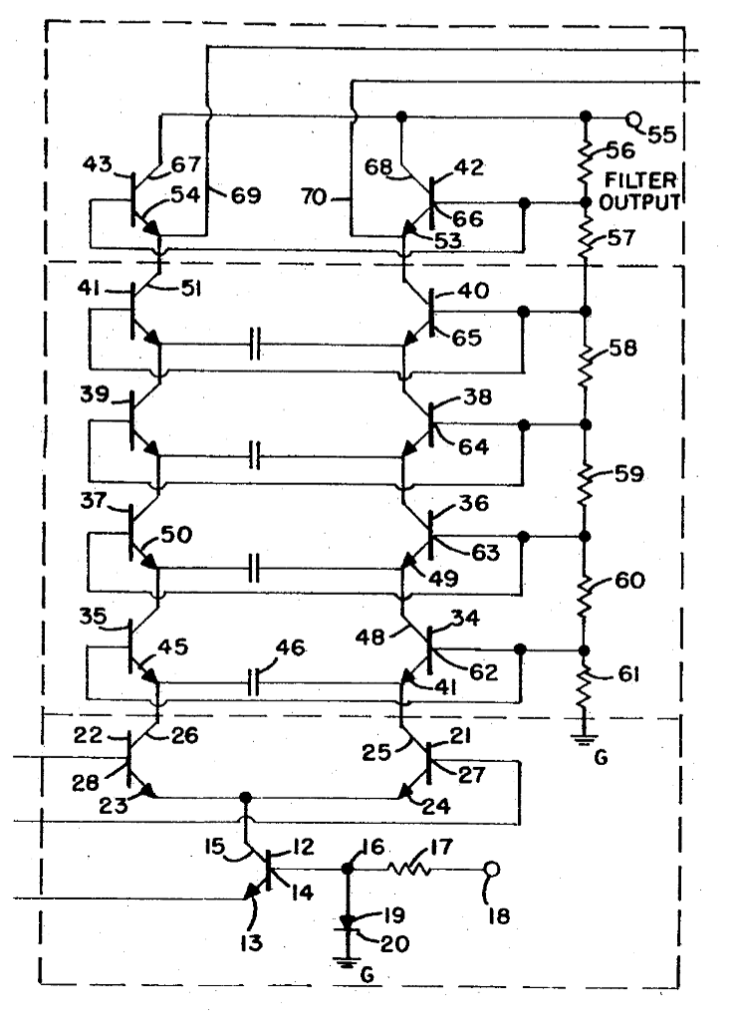
Since the resistance of a transistor (each labelled 34 to 43) is dependent upon the bias current passing therethrough, an adjustment to this bias current (which is easy to achieve with a control voltage) leads to a change in resistance. This voltage-controlled resistance could be combined with a capacitor (on each rung of the ladder, labelled 46) to produce a filter with an adjustable cutoff frequency, with the steepness of the cutoff being affected by the number of rungs. Note that the bias current passes through the transistors at the same time as the (much smaller) input audio signal. To remove the bias current, the output of one side of the ladder is subtracted from the other, which cancels out the bias current while leaving the filtered signal behind.
This “ladder filter” was responsive, stable, and relatively inexpensive to manufacture. Its iconic sound became highly desirable and it was incorporated not just into the original Moog synthesiser, but also into Moog’s subsequent products such as the highly successful Minimoog in 1970.
Moog’s success inspired several competitors to develop and release their own synthesisers, such as Electronic Music Studios (EMS) in the UK and ARP Instruments in the US. In the mid-1970s, ARP overtook Moog to become the largest synth manufacturer in the world. ARP had innovations of their own (e.g., see US3369128) such as solving the pitch stability issues present in Moog’s products (perhaps particularly noticeable in track 4 of Switched-On Bach). ARP’s successful ARP2600 synthesiser was used to produce the sounds of R2-D2 in the Star Wars films. Here in the UK, the EMS Synthi was used by Pink Floyd to provide the synth part on their song “On The Run” from the album Dark Side of the Moon.
Despite the stiff competition, Moog’s ladder filter patent turned out to be useful in keeping these competitors (partially) at bay. Prior to 1976, the ARP2600 used a filter (the “4012 filter module”) that was very similar to Moog’s ladder filter. However, due to the threat of legal action from Moog, ARP had to redesign the filter module for the models sold from 1976 (though many believe the sound of the updated “4072 filter module” to be inferior to the original). The EMS Synthi mentioned above had to be designed with an alternative form of ladder filter that used diodes instead of transistors to work around Moog’s patent (and a useful explanation of the design process of a diode-based ladder filter can be found here).
It should be noted that Moog could probably have obtained other patents for the other concepts he developed (e.g. his VCO designs or his envelope generator). Had he fully appreciated their potential impact and filed patent applications accordingly, then he may have been able to capture an even larger slice of the market.
In the end, although analog synthesisers remained popular throughout the 1970s, they would eventually be displaced by digital alternatives, some examples of which will be discussed in the next instalment of this series.
If you would like to discuss anything in this article further, or you have an invention that you would like to protect, then please contact the author, or get in touch with our patents team at gje@gje.com.
Related resources

FT ranks GJE No. 1 patent law firm in Europe for 8th consecutive year
GJE is proud to have been awarded six gold rankings in the FT’s survey of Europe’s leading patent...
Theremin: What the world’s purest sounding instrument can teach us about heavy metal music
The theremin is one of the most fascinating intersections of physics, engineering, and music history.

Birth of the synthesiser: Was the US Supreme Court wrong (twice) about its inventor?
Like many technological developments in the early 20th century, the first electronic oscillators were made possible by vacuum...