
Recommended listening: The Beatles – Lucy In The Sky With Diamonds
Music has changed dramatically over the last century. Although much of this change can of course be attributed to the creativity of the musicians and performers, the role of technology in the creation, processing and recording of audio is probably underappreciated. Therefore, this article marks the first in a series that will explore some of this technology further with the help of several landmark patent filings. Additionally, each article will be paired with a song or album to demonstrate the impact of that technology on the musical world. If you haven’t already, then queue up my recommendation – Lucy in the Sky with Diamonds – before you read on, paying particular attention to the first sound that you hear…
When exploring the overlap of music with technology, it makes sense to start with the synthesiser, which can be generally defined as an electronic instrument that produces artificial sound. The fundamental starting point for any synthesiser is the electronic production of an audible oscillation, and components that perform this function are known as “oscillators”.
Like many of the most important technological developments in the early 20th century, the first electronic oscillators were made possible by the vacuum tube (or “thermionic valve”). This was invented by English physicist John Ambrose Fleming in 1904 (see US803684). In summary, a vacuum tube is formed from an evacuated glass bulb enclosing a plurality of electrodes. When a filament (the cathode) is heated, electrons are emitted into the interior of the bulb via “thermionic emission” and subsequently attracted to a plate (the anode) such that a current flows therebetween. This behaviour made the vacuum tube useful as a type of diode.
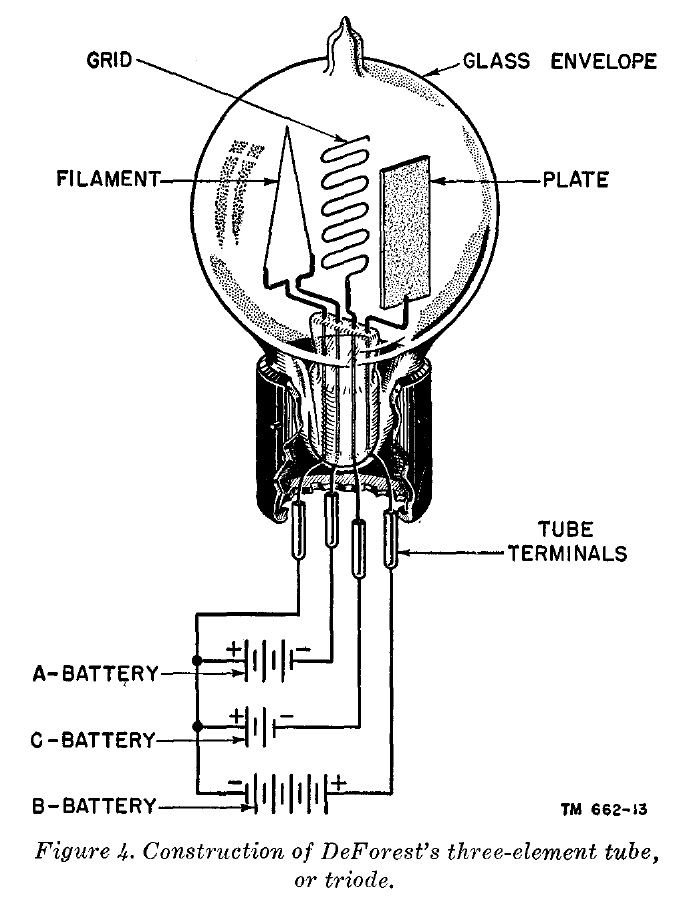
In 1908, American inventor Lee de Forest discovered and patented a modification known as the “triode” (see US879532A), where a control signal could be applied to a grid located between the anode and the cathode. The grid produced an electric field that influenced the movement of electrons between the cathode and the anode. As a result, even a small signal at the control grid could be amplified to produce a much larger signal between the anode and cathode.
The triode had several useful properties; its ability to amplify an electrical signal made it very useful not just for musical applications (as we will discuss further in the next instalment of this series), but also for telecommunications (e.g. to provide relays for long distance calls). Furthermore, it was also discovered that connecting a triode in feedback with itself could produce a sinusoidal oscillation, and thus the first electronic oscillator was born.
Deciding exactly who had made this discovery was very messy, since several individuals discovered and filed patents for the technology substantially simultaneously. At this point, the right to a US patent was not given simply to the first person to file a patent application for a concept but to the first person to actually invent the concept.
To briefly summarise the dispute (which has been described as “the most complicated patent litigation in the history of radio”), inventor Edwin Armstrong was initially successful in having his patent (US1113149) upheld, but his right to the concept was later revoked in subsequent decisions from an appeals court and twice at the US Supreme Court in 1928 and 1934. The individual who won the dispute was none other than Lee de Forest, who had observed oscillations before Armstrong (even though he did not understand the underlying cause, and was even trying to eliminate them entirely). His victory can be attributed in part due to a strategic error by Armstrong in prosecuting his patent portfolio, and in part due to some well-considered amendments to the operating frequency range by de Forest’s patent attorney. Nowadays, the outcome of the dispute is still very controversial, and the oscillator is often still referred to as the “Armstrong oscillator”.
Although the sinusoidal oscillations from the vacuum tube were an important step forward, you are unlikely to hear the Armstrong oscillator in musical recordings since it only generated an oscillation at a single frequency. However, almost all musical sounds are made with a combination of hundreds of frequencies (known as “harmonics”), so the next task was to find a way to produce a complex waveform with vibrations at multiple frequencies.
The innovation that addressed this was the aptly named “multivibrator”. The first of these was invented by Henri Abraham and Eugene Bloch in 1919. Their circuit combined two vacuum tubes in a manner that caused the signal to “flip-flop” between two unstable states, thereby generating a square-shaped wave (which includes harmonics at odd-number multiples of the lowest frequency). A bistable variation of the circuit was invented by British physicists Eccles and Jordan shortly thereafter, who received a patent in 1920 (GB148582A).
The video below shows a comparison of the Armstrong oscillator and the Eccles-Jordan multivibrator together with their output waveforms.
Due to its ability to produce a harmonically rich square wave, the Eccles-Jordan circuit caught the attention of American organ manufacturer Frederick Lowrey in the early 20th century, and variations of the circuit were put to use in several of Lowrey’s most popular electric organs. The Eccles-Jordan circuit provided a distinctive bright sound that distinguished the Lowrey organs from others being produced at the time (e.g. the smoother-sounding tonewheel organs produced by Hammond), and Lowrey organs can be heard in many well-known works from the 1960s and 1970s.
For example, the opening of Lucy In The Sky With Diamonds, was created with a Lowrey DSO Heritage organ that included the Eccles-Jordan circuit. Another tube-based organ, the Lowrey Festival is prominently featured in the song “Chest Fever” by The Band and several organs (including those made by Lowrey, Hammond and Wurlitzer) were recorded for The Beatles’ “Being for the Benefit of Mr. Kite”.
From the 1970s, tube-based organs began to fall out of favour due to their lack of reliability and large power requirements, and Lowrey’s organs started to use (much more reliable and energy efficient) solid-state electronics. Nevertheless, vacuum tubes remain a core part of the sound of many modern recordings (and this will be explored further on the next instalment of this series.)
In view of the substantial impact and commercial value of the vacuum tube oscillator on the musical world, it remains unfortunate that Armstrong was not able to leverage the patent system effectively to protect an innovation that many still believe to be rightfully his; this is a testament to the complexity of the patent system and it demonstrates the need for inventors to obtain relevant advice from professionals who understand both their technology and the legal systems used to protect it.
If you would like to discuss anything in this article further, or you have an invention that you would like to protect then please contact the author, your usual GJE attorney, or get in touch with our patents team at gje@gje.com.
Related resources

PCM – the invention hiding within every song you hear
In the final article of the series, Alexander Norden explores the monumental impact this invisible technology has had...

The Mellotron – How an instrument borrowed from America fuelled the British Invasion
In this article, Alexander Norden explores the inner workings of the Mellotron and the controversial story behind its...

FM synthesis – How one of Stanford University’s most profitable licensing deals defined the sound of the 1980s
In the latest instalment of our music technology series, patent attorney and amateur musician, Alexander Norden explores the...