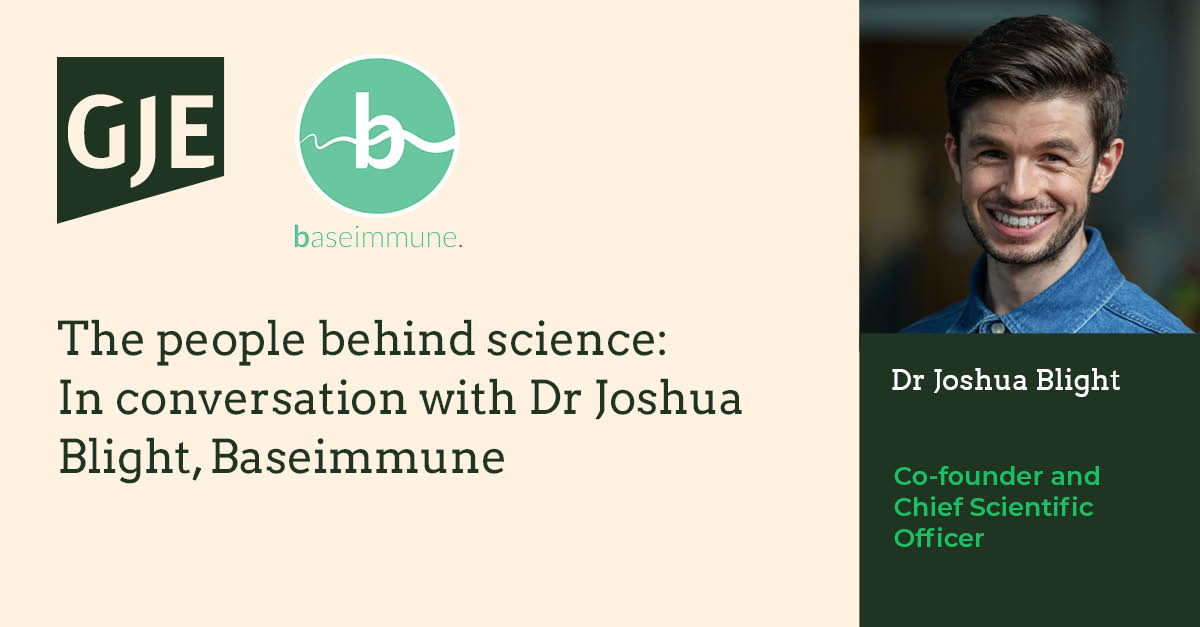
To mark London Life Sciences Week 2026, we are delighted to feature an interview with Dr Joshua Blight, Co-Founder and CSO at Baseimmune, a London-based immunotherapies start-up. Together we explore his perspectives on the evolving life sciences sector, the opportunities and challenges shaping the industry, and his personal experiences throughout his career.
Tell us about your career journey and what initially attracted you to the life sciences sector.
What attracted me to life sciences was the opportunity to understand how biology works and use that understanding to do something useful for patients. The immune system is particularly fascinating because of its ability to recognise, adapt and remember. Learning how to direct those capabilities opens up enormous possibilities for preventing and treating disease.
My academic career included research at Oxford’s Jenner Institute and Imperial College London, where I developed my expertise in immunology and vaccine development. That experience reinforced my enthusiasm for tackling difficult biological problems and pursuing a career focused on developing new medicines.
I later co-founded Baseimmune, where we are building new approaches to therapeutic design, and I now lead our scientific direction as CSO. Combining scientific research with building a company has broadened how I think about scientific progress. A compelling idea is the starting point; bringing it closer to patients also takes the right team, focused development and a clear understanding of the disease you are trying to treat.
In your view, what are the most exciting opportunities emerging in the life sciences sector today?
For me, one of the most exciting opportunities is the potential of active immunotherapies to treat chronic diseases. Teaching the immune system to generate a therapeutic response could open up new ways to manage disease and achieve durable benefits for patients.
A central part of that opportunity is addressing multiple disease pathways together. Complex chronic diseases often involve interconnected mechanisms, and blocking one pathway can leave others driving disease or compensating for the intervention. Designing therapies around that complexity, with the ability to influence several relevant pathways, could offer meaningful advantages. That multi-pathway approach is central to what we are building at Baseimmune.
Computational approaches have an important role to play in realising this potential, but their value depends on how thoughtfully we use them. The relevance and quality of the training data, the biological assumptions behind a model, and the question being asked all matter. Simply adding more data or building a larger model does not guarantee a useful biological answer.
The strongest approaches combine computational design with established research, existing tools and experimental expertise. Predictions need to be tested, and those results should inform the next round of design. I see enormous opportunity in that close relationship between computation and biology, helping us design better therapies and make better decisions about what to take forward.
What do you see as the biggest challenges the industry will need to address over the next 5 to 10 years?
I think the central challenge will be translating increasingly sophisticated science into treatments that deliver meaningful clinical benefit. Generating more candidates only helps if we can make better decisions about which ones to advance. That requires disease-relevant models, informative biomarkers and experiments that test the assumptions most likely to determine success or failure.
We also need to consider manufacturing, access and practical use earlier in development. A therapy’s ultimate value depends on whether it can reach patients and fit into healthcare delivery. Those considerations should help shape development decisions from the outset.
Based on your personal experience, what insights, lessons, or perspectives would you like to share with others working in or entering the industry?
One lesson from building Baseimmune is that a technology can have many potential applications, but a company needs to make clear choices about where to focus. You have to ask where your approach offers a meaningful advantage, what evidence would demonstrate that advantage, and whether you have the resources to generate it.
I have also learned the value of being willing to change your mind. You need enough conviction to pursue an ambitious idea, while remaining open to evidence that changes the programme or your priorities. Creating a team environment where people can challenge assumptions is essential to that.
For someone entering the industry, I would encourage them to spend time with people outside their own discipline. Understanding how clinicians, developers, investors and patients see a problem can make you a better scientist. It helps you connect the experiment in front of you with the decisions that will eventually determine whether a treatment reaches someone who needs it.
What skills or mindsets do you think are most important for driving innovation in the life sciences sector?
Scientific depth matters enormously, but so does the ability to work across disciplines. Some of the most useful insights emerge when people with different expertise can understand one another well enough to solve a problem together. Clear communication, good listening and the confidence to ask basic questions are valuable skills.
I also place a high value on experimental judgement: knowing which question matters most, designing a test that can answer it, and being honest about what the result does and does not tell you. As computational tools become more capable, that judgement becomes even more important.
Finally, innovation needs curiosity, resilience and humility. You need to be comfortable with uncertainty, willing to learn unfamiliar things and able to respond constructively when an idea fails. The teams that make progress are those that turn uncertainty into testable questions and use what they learn to make better decisions.
To discuss your biotech IP strategy, please contact our biotech team: biotech@gje.com
Related resources
The people behind science: In conversation with Dr Livija Deban, Prokarium
We sat down with Dr Livija Deban to discuss the successes and challenges that Prokarium have faced as...

Turning science into value: Top tips for an effective life sciences IP strategy
With London Life Sciences Week starting on 15 November, we’re sharing our top ten practical tips for building...
“An outstanding IP service” – GJE rises to Band 1 in Chambers UK 2027
GJE is delighted to be ranked in Band 1 as Patent & Trade Mark Attorneys in Chambers UK...